
For aluminum-only weld prep, buy an insert-type milling disc. It costs a fraction of a solid-carbide disc to buy, and when the edges dull you swap the inserts at the bench instead of sending the disc out for resharpening.
A solid-carbide milling disc is the better pick when you also cut steel, stainless or titanium, open weld roots from both sides, or want the longest total life per disc. Both designs cut chips instead of throwing grinding dust, and both beat flap discs on aluminum.
Inmotion supplies both in the US.

What is an aluminum milling disc?
An aluminum milling disc cuts metal with carbide edges, where abrasives wear it away with grit. That changes three things on aluminum, and all three hold for either design.
No embedded grit. Aluminum is soft, and abrasive wheels can leave foreign material in the surface. Fronius, a welding equipment maker, tells fabricators to “avoid consumables such as a grinding wheel or sandpaper that can embed foreign material into the base metal.” MSC Direct’s aluminum guide says porosity can occur when contaminants from abrasive products release from the wheel and contaminate weld surfaces. A carbide edge has no resin-bonded grit to leave behind.
Chips, not fine dust. OSHA’s combustible dust guidance lists aluminum among the metals that can be explosible in dust form, even though a block of aluminum won’t burn. Grinding makes that fine dust. Milling makes chips you can sweep up. That cuts the airborne dust. It doesn’t replace housekeeping, and shops handling combustible metal dust should still work to NFPA 484, the standard for combustible metals.
No loading. Heat and friction make aluminum stick to an abrasive until, as MSC puts it, “this loading or clogging of material eventually prevents the abrasive from cutting.” A cutting edge clears chips instead.

If you’re still on flap discs, our longer piece on why grinding discs fail on aluminum covers the mechanics. The rest of this article is about choosing between the two carbide designs.
Solid carbide or insert type: how the two designs differ
Solid-carbide milling disc. One piece of carbide, made in Germany to EN 847-1. It runs 300 to 500 hours per cycle and gets resharpened 5 to 7 times, for up to 4,000 hours of total life. It comes single-sided, double-sided or as a Doubleworker. Inmotion coordinates the resharpening. Our product page is /milling-disc/.
Insert-type disc. A reusable disc body with five replaceable carbide inserts. When the edges dull, you fit new inserts yourself. The version we point readers to is a 4-1/2” disc with a 10 mm cutting width, listed for non-ferrous metals only, and its listing names root weld opening among its uses alongside chamfering and seam trimming.
What happens when the edge goes dull?
This is the real difference in daily work.
- 1Disc dulls After 300 to 500 hours the cut slows and the finish gets worse.
- 2Ship it out The disc goes to Inmotion, which coordinates resharpening through the manufacturer.
- 3Work continues on a second disc Shops that can't stop weld prep keep a second disc to bridge the gap. That is extra capital on the shelf.
- 4Disc comes back Resharpened and ready for another cycle. Five to seven cycles per disc.
With the insert disc, there is no loop. You reorder inserts, swap them at the bench and keep going. No shipping, no second disc waiting.
That convenience is the case for the insert design. The case for the solid disc is in the table below.
Solid carbide vs insert disc: side by side
| Solid-carbide milling disc | Insert-type milling disc | |
|---|---|---|
| Upfront cost | Several times the insert disc | Lower |
| When the edge dulls | Resharpen: send the disc out, get it back | Replace the inserts on site |
| Downtime | Disc is away during resharpening; plan a second disc | Only the time to swap inserts |
| What you reorder | Nothing until the disc is worn out after 5 to 7 resharpenings | Inserts |
| Aluminum | Yes, 8,500 to 15,300 rpm | Yes |
| Steel | Yes, with steel-specific geometry at 1,800 to 3,200 rpm | No, listed as not for ferrous metals |
| Disc geometries | Single-sided, double-sided, Doubleworker | 4-1/2" disc, 10 mm cutting width |
| Chips vs dust | Chips | Chips |
| Best for | Steel and mixed materials, double-sided root work, longest total life | Aluminum-only prep including root opening, lower entry cost, no send-out cycle |
We left out the price of replacement inserts and edge life on purpose. We don’t have verified numbers for either, and we won’t guess. Ask your insert disc supplier before you budget.
Which aluminum milling disc should you buy?
If your situation is mixed, the material usually decides. Steel, stainless and titanium point to the solid disc.
Where to get the insert disc in the US
Inmotion’s US partner for the insert design is Heavy Hitters, which sells it as the AluCarver. In their shop it carries their own name, Duz-AL 4-1/2” Non-Ferrous Milling Disc, so look for that. It’s a 4-1/2” disc body with five replaceable carbide inserts and a 10 mm cutting width, for aluminum and other non-ferrous metals. The listing names root weld opening, chamfering and seam trimming. It’s not for ferrous metals.
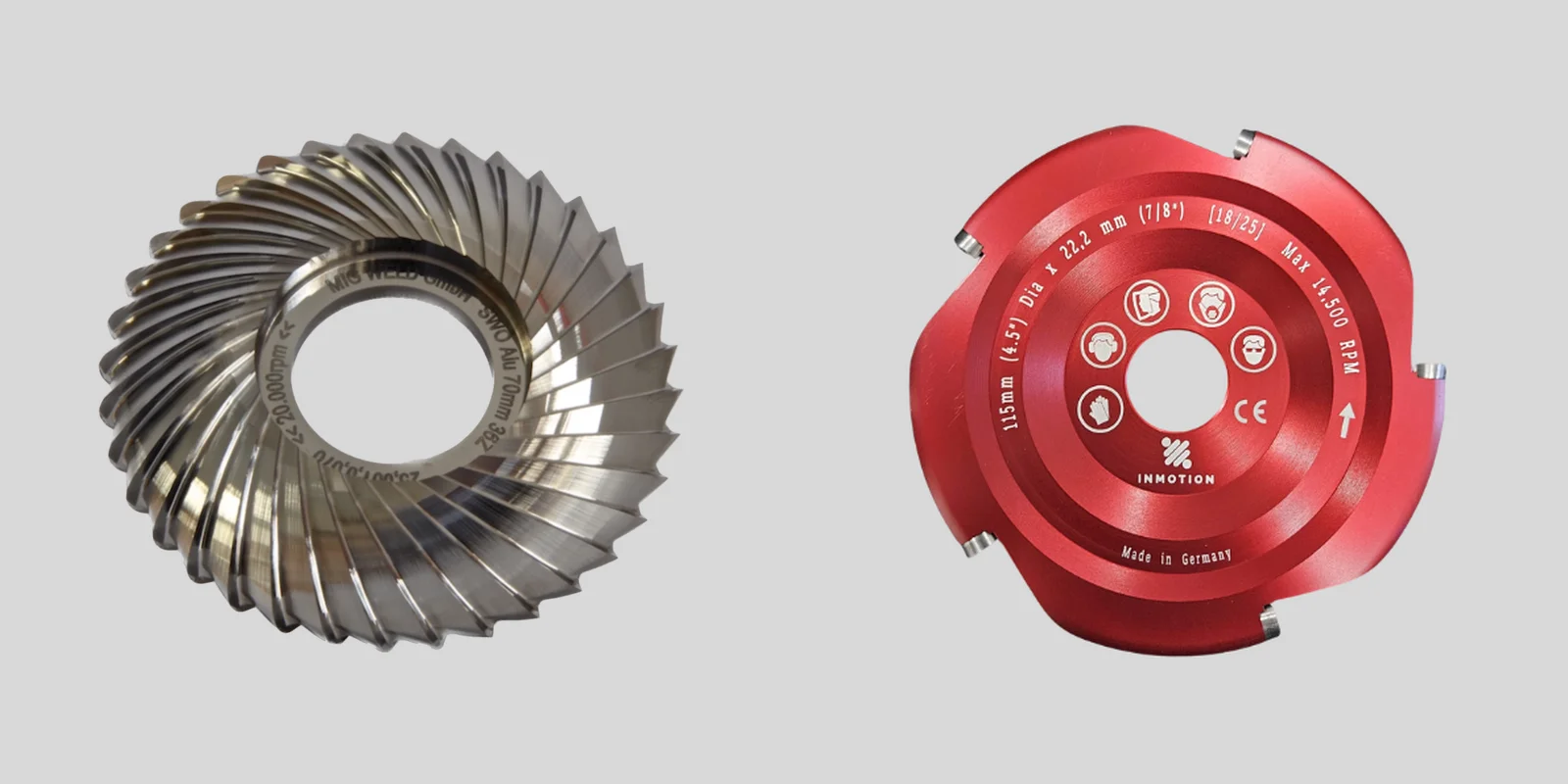
Aluminum only? Get the insert disc through Inmotion's US partner.
See the AluCarver at Heavy Hitters →How to run an aluminum milling disc
Most weld prep we see is aluminum: bevels, V-grooves, seam trimming, cleaning up cast flash before re-welding. Both designs fit.
Steel changes the picture. A solid-carbide disc with steel geometry works, but it runs at 1,800 to 3,200 rpm rather than aluminum’s 8,500 to 15,300, and it’s a different disc. The economics differ too, so run the numbers for your volume. The insert disc isn’t an option here, since its listing says it isn’t for ferrous metals.
For the solid-carbide disc, use an electric or pneumatic angle grinder rated for at least 1,500 W and 12,000+ rpm.

Match the disc to the material
Don’t run an aluminum disc on steel, or the reverse. Tooth geometry and rpm are set per material. For the solid-carbide disc, the grinder baseline is at least 1,500 W and 12,000+ rpm.
Not sure which disc fits your work?
Which disc fits my work?
Material, joint type, how many hours a week you prep. You get a straight answer on solid carbide or insert type.
A US-based specialist replies within 1 business day.
Thanks, we've got it.
A US-based specialist will come back with a recommendation within 1 business day.
Prefer to talk now? → +1 312 547 9253 · office@inmotion.global
Featured Hardware
Rotary Milling Disc
Steel, double-sided discs or the longest total life? Tell us your material and the work.
Request a milling disc quote →Frequently Asked Questions
What is an aluminum milling disc?
A disc for an angle grinder that cuts aluminum with carbide teeth instead of grinding it with abrasive grit. It removes material as chips, so there is no abrasive to embed in the part. Two designs exist: a solid-carbide disc that gets resharpened, and a disc body that carries replaceable carbide inserts.
Can you use a milling disc on aluminum?
Yes, aluminum is the main use. A solid-carbide aluminum disc runs at 8,500 to 15,300 rpm depending on diameter. Insert-type discs for non-ferrous metals exist too. Match the disc to the material.
Is a milling disc better than a flap disc on aluminum?
For weld prep, usually yes. A milling disc cuts chips and leaves no abrasive residue. A flap disc can embed grit in soft aluminum and load up with smeared metal, and grinding throws fine aluminum dust into the air.
Which is better for aluminum, a solid-carbide or an insert-type milling disc?
For aluminum only, we recommend the insert type. It costs less to start with, and there is no resharpening loop. Pick solid carbide if you also cut steel, stainless or titanium, open roots from both sides, or want the longest total life per disc.
Can a milling disc be resharpened?
A solid-carbide milling disc can. Inmotion's disc runs 300 to 500 hours per cycle and can be resharpened 5 to 7 times, for up to 4,000 hours of total life. It goes out for resharpening and comes back. An insert disc isn't resharpened. You replace the inserts.
What rpm does an aluminum milling disc run at?
A solid-carbide aluminum disc runs at 8,500 to 15,300 rpm depending on diameter.
What angle grinder do I need?
For a solid-carbide milling disc, an electric or pneumatic angle grinder rated for at least 1,500 W and 12,000+ rpm.